piTokenomics

Designed to maximise user ownership, reward long-term holders, and distribute real protocol value.

TLDR

Noon has built the most user-friendly tokenomics system in web3, designed to:

  1. Maximise $NOON token allocation to users: 65-80% to users

    1. Among users, prioritise distributions to long term users and holders, as opposed to short term sellers

  2. Ensure all token distribution is done transparently, and over as long of a term as possible

  3. Maximise the value of holding $NOON

    1. Allow holders ultimate control over the protocol

    2. Distribute real value, real returns, to users

At every decision point, we asked ourselves, "How can we make the tokenomics as favourable to our users as possible?". We think we've been able to deliver on our ambitious goals.

1. Token allocation

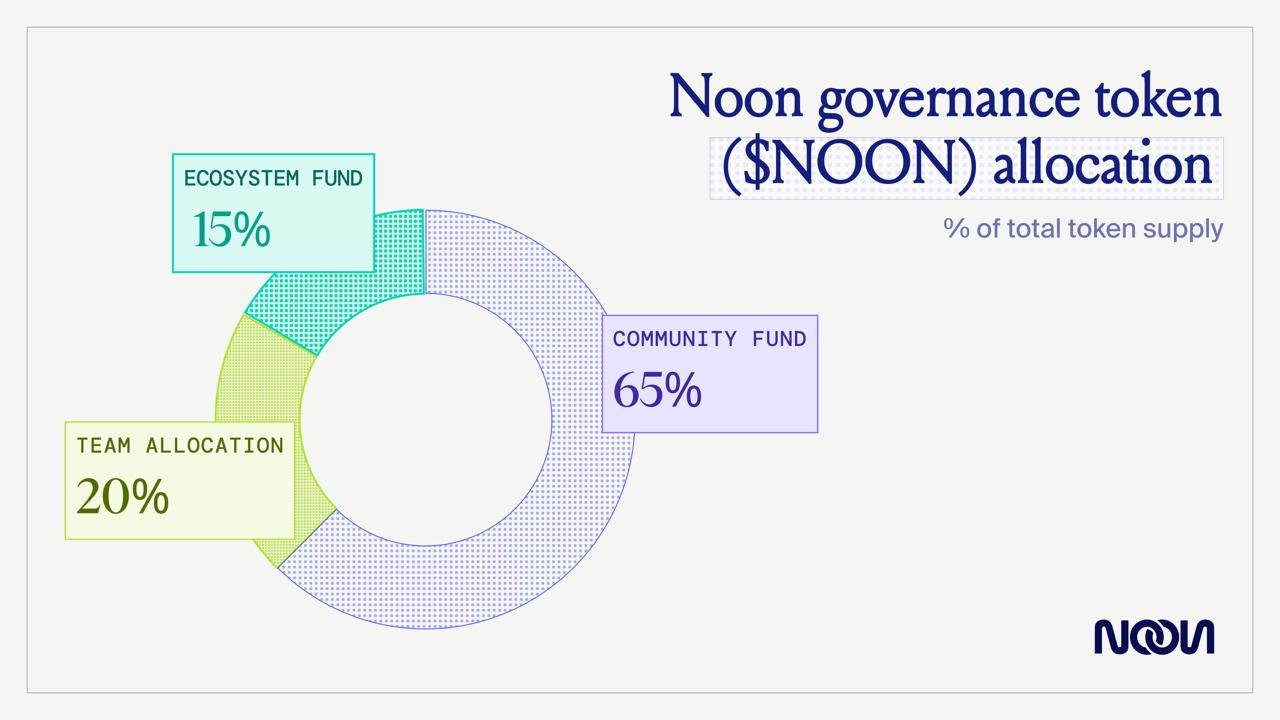
We aim to allocate as many $NOON tokens to users as possible. The $NOON governance token allocation is very simple (figure 1).

  • 65% is allocated to the Noon Community Fund. This is the fund which distributes tokens to users of the Noon Protocol, based on their holdings and activity within our protocol.

  • 15% is allocated to the Noon Ecosystem Fund. This is the fund which is used by the Noon Foundation to accelerate the growth of the Noon Protocol. We will aim to also distribute this to Noon's users.

  • 20% is allocated to Noon's team. This will be distributed to the Noon team. More details on this in Section 3.

Figure 1. Noon governance token ($NOON) allocation
There is an absence of investors and early LPs (with preferred terms) on the token allocation table to date. These are two groups which typically receive a significant token allocation from most (stablecoin) projects. Noon has 0 $NOON tokens allocated to both.

  • Noon is self-funded, and has no plans to take on external investment at this time.

  • Noon has grown its TVL organically, and has not relied on preferential deals with early LPs

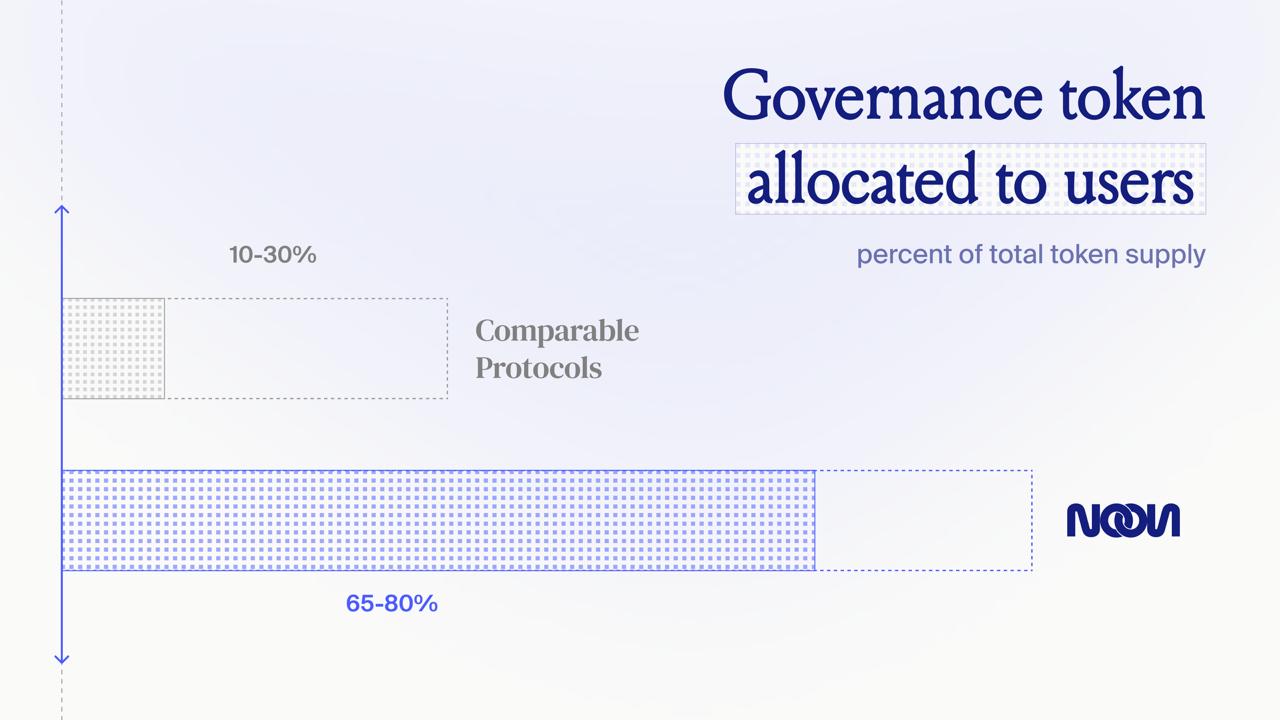
Both of these mean that we can maximise $NOON token distribution to you, our users. While most comparable projects allocate between 10-30% of governance tokens to users, Noon will distribute between 65-80% of governance tokens to our users (figure 2).

Figure 2. Governance tokens allocated to users
1.1. Token distribution: prioritise long term users and holders

After ensuring that we maximise distributions to our users, we then wanted to ensure that our long term users and holders were receiving the highest rewards. This is why we developed unique staking reward mechanisms and a bespoke vesting curve for governance token rewards.

Active Staking

Active Staking is currently live on Noon. This refers to users who earned $NOON through holding our stablecoins (USN & sUSN), or using either across our partner protocols. These users each earn an initial allocation of $NOON on a monthly basis, which can be increased by staking this $NOON for up to 12 months.

Open Staking

Open Staking is coming soon to Noon. This will be available to users once the $NOON token is transferable - and available to buy and sell on CEXes and DEXes. Open staking will allow users who have bought $NOON, or any other users ineligible for Active Staking, to also receive additional $NOON by staking in the Open Staking pool.More details on Open Staking to be disclosed closer to $NOON transferability (coming soon).

Staking Rewards Curve

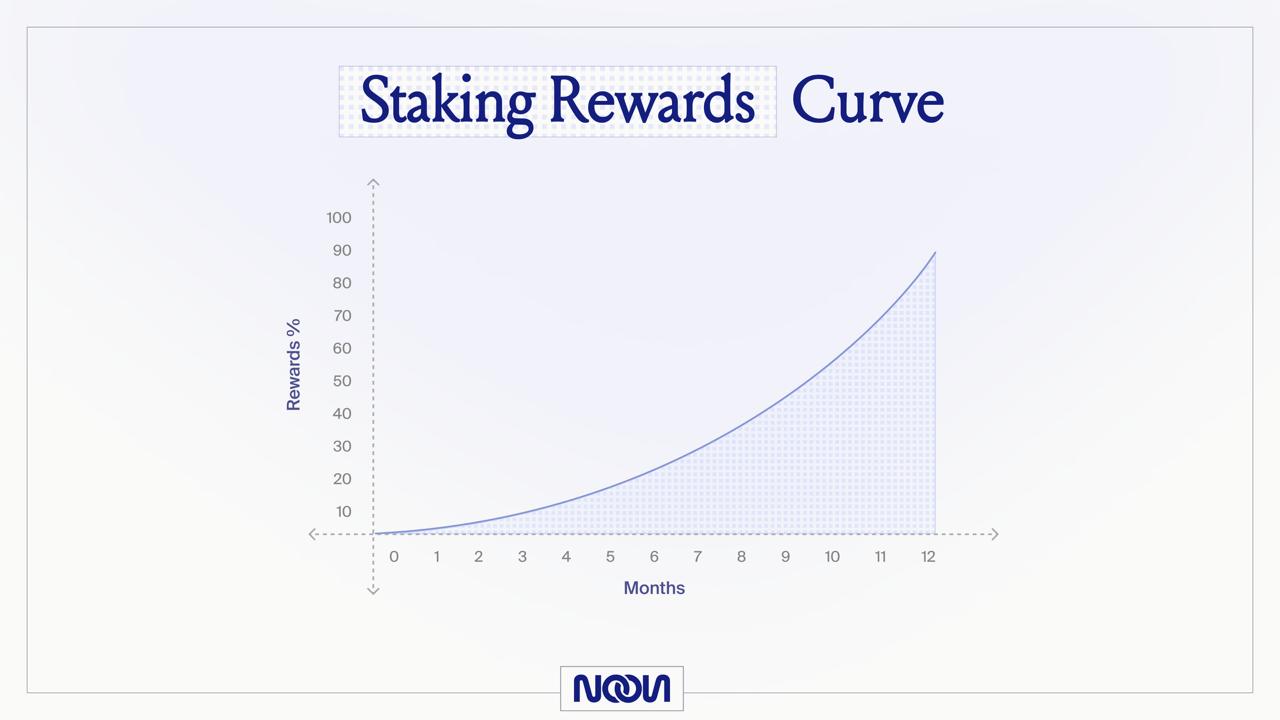
Both Active Staking and Open Staking will share the same Rewards curve. This will be an exponential curve, to emphasise the rewards to long term users. The curve will follow the function in figure 3.

Figure 3. Noon Staking Rewards Curve

2. Long term, transparent token distribution

We aim to distribute our governance tokens transparently, over as long of a period as possible.

2.1. Community Fund

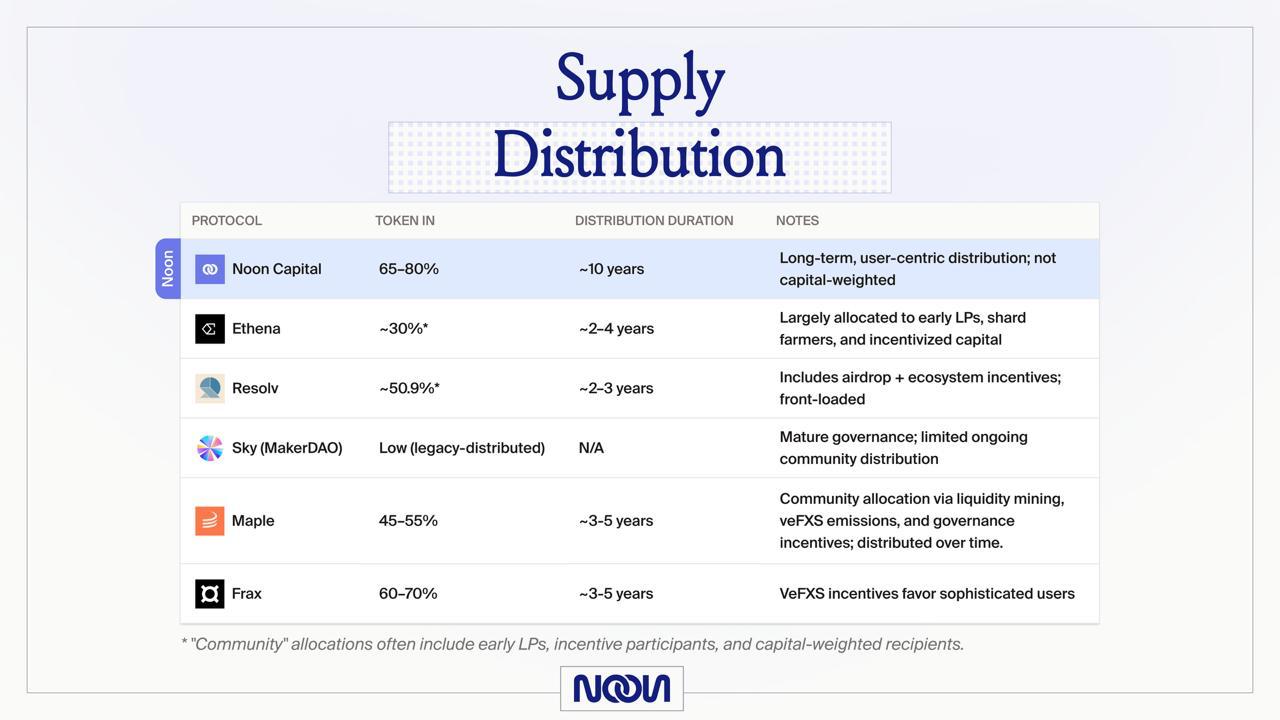
Distributing the 65% of governance tokens in our Community Fund should not be done overnight - or in a year or two, which is how other comparable protocols choose to distribute their governance tokens. Instead, we can distribute our Community Fund to users over 8 years, or longer (figure 4).

Figure 4. Noon v Comparable Protocols: Governance Supply Distribution
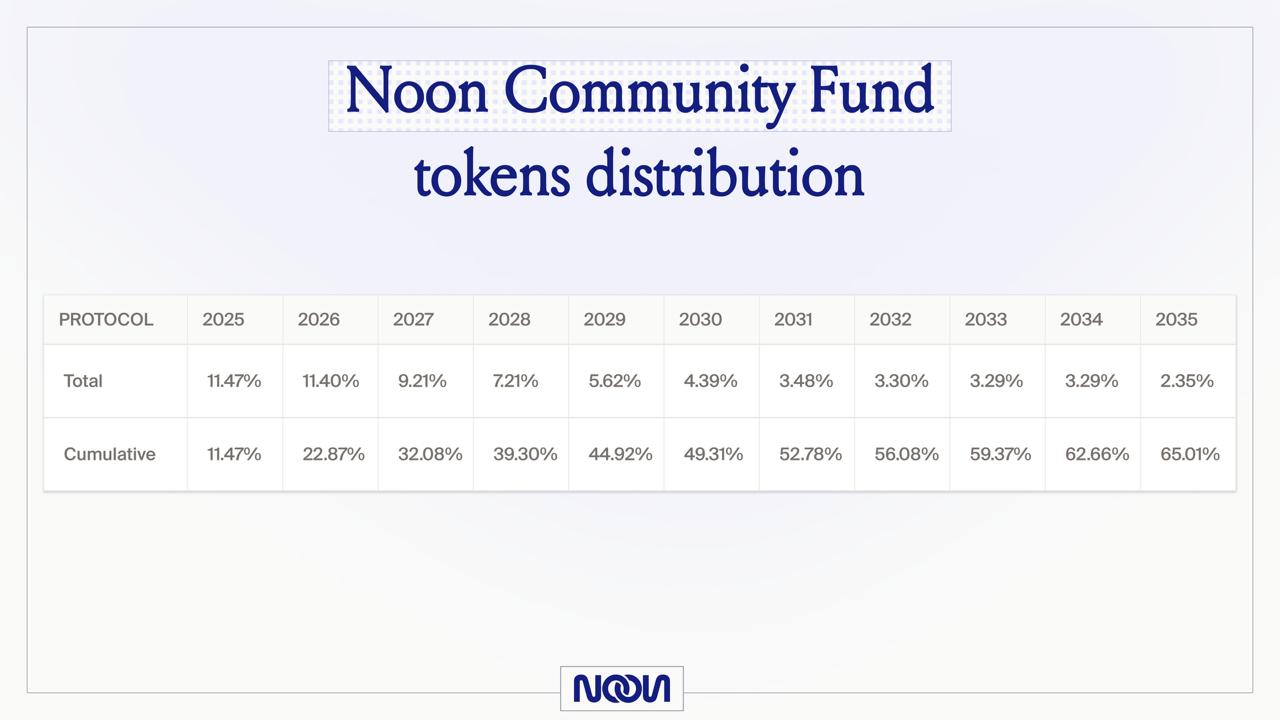
This increases incentives for Noon users, specifically for holding USN, our non-yield bearing asset. This is important for all our users to understand. One of the ways we are able to offer higher APYs than comparable protocols is because we reward USN holders with $NOON rewards disproportionately (compared to sUSN holders). This incentivises holding USN. And as USN holders forgo the yield earned by their holdings in favour of sUSN holders, this boosts sUSN yields. The longer we can incentivise USN holders with $NOON rewards, the longer we can sustain our boosted sUSN yields. We've seen comparable protocols lose similar yield boosts immediately after they reduce governance token emissions - we are fortunate that we're able emit governance tokens for 8+ years, to sustain this yield boost for significantly longer than others (figure 5).

Figure 5. Noon Community Fund distribution, by year

This will be done transparently, from the following wallet. Noon Community Fund wallet: Contracts and addresses

2.2. Ecosystem Fund

The Ecosystem Fund is set up to allow the Noon Foundation the ability to promote ecosystem growth. This has been unlocked at TGE (in July 2025). All distributions from the Ecosystem Fund will be proposed by the Noon Foundation, and be disclosed to the Noon community in a timely manner. Noon Ecosystem Fund wallet: Contracts and addresses

2.3. Team allocation

All tokens in Noon's Team allocation (20% of total token supply) will be vesting over 7 years - an initial 1-year cliff, followed by 6 years of linear, monthly vesting. This compares favourably to comparable protocols, which have team vesting periods ranging from 18 months to 4 years. We chose a market leading vesting period because we understand that Noon's vision is long-term, and cannot be achieved by the team while adhering to a standard vesting schedule. This aligns the team most closely with users.

3. Maximise the value of holding (and staking) $NOON

As part of our tokenomics exercise, we also wanted to ensure we considered how we could increase the value of holding $NOON.

3.1. Governance utility

$NOON is the governance token of the Noon Protocol. Its primary purpose is to ensure that control of key protocol decisions sit with long-term users, rather than external investors or short-term participants.Holders (specifically, stakers) of $NOON will be able to participate in governance decisions including, but not limited to:

  • Protocol parameters and risk limits

  • Deployment strategies and counterparty selection

  • Adjustments to token emissions and incentives

Governance power is intentionally concentrated among long-term users. Since the majority of $NOON is distributed to users over an extended period, governance authority naturally accrues to those whose incentives are most closely aligned with the protocol’s long-term success. Additionally, long-term stakers of $NOON receive increased governance voting power, further amplifying the influence of committed participants.

3.2 Raw Returns to $NOON holders

Noon is designed to maximize the long-term value of holding and staking $NOON. A meaningful share of protocol value flows to $NOON stakers (via the Noon Insurance & Operations Funds), aligning governance participation with sustainable protocol growth and prudent risk management.There are two primary mechanisms through which raw protocol returns accrue to $NOON holders:

Insurance Fund

  • 10% of raw protocol returns are allocated to the Insurance Fund.

  • These funds are seasoned for 6 months to ensure adequate protection against adverse protocol events.

  • Any Insurance Fund capital not required to cover losses is distributed pro-rata to $NOON stakers.

This structure creates a direct yield stream for $NOON stakers, while simultaneously incentivising responsible governance and risk oversight.

Operations Fund

  • 10% of raw protocol returns are allocated to the Operations Fund.

  • The Operations Fund is used to cover ongoing monthly operating expenses, while maintaining a reasonable operating buffer.

  • All excess funds, beyond operational needs and the buffer, are distributed pro-rata to $NOON stakers.

This ensures that protocol revenues are used efficiently and that any surplus value is returned to the community, rather than accumulating at the protocol level.

3.3. $NOON Buybacks: Enhancing Holder Value

We have described above how we minimise sell-side pressure of $NOON with our distribution schedule (section 2). But we also have a compelling buy-back program to build significant buy-side pressure for $NOON.Distributions from the Insurance Fund and the Operations Fund (see 3.2) are distributed to staked $NOON holders via the following mechanism:

  • Funds in both the Insurance Fund and the Operations Fund are held in USDT or USDC

  • These funds are used to buy back $NOON on the open market

  • $NOON is then distributed to $NOON stakers (pro-rata)

N.B. This $NOON, once distributed to $NOON holders (stakers), is eligible for Open Staking (section 1.1), incentivising the ongoing staking of these $NOON tokens as well.

Summary

By combining long-term governance ownership, extended token vesting, and direct participation in protocol returns, $NOON is designed to represent real, durable ownership in the Noon Protocol. Every component of the system is structured to reward users who contribute to Noon over the long term, rather than short-term speculators.

Last updated