> For the complete documentation index, see [llms.txt](https://docs.noon.capital/llms.txt). Markdown versions of documentation pages are available by appending `.md` to page URLs; this page is available as [Markdown](https://docs.noon.capital/2.-usdusn-and-usdsusn/cross-chain-interoperability.md).
# Cross-Chain Interoperability
**$USN** and **$sUSN** exist across multiple chains, this page explains how. To move your assets between chains, see [**Bridging Operations**.](/2.-usdusn-and-usdsusn/cross-chain-interoperability/bridging-operations.md)
## How cross-chain bridging works
Ethereum is **$USN**'s **canonical home chain**. On other chains, **$USN** is available through **Hyperlane** and **LayerZero**, interoperability protocols.
The specific bridge mechansims use **lock-and-mint** or **burn-and-mint model,** depending on the origin and destination chain. See specific details below, in the **Bridging Mechanism** section.
Across all of **Noon**'s briding mechanisms, the goal is to keep **total supply consistent** across chains. For example, tokens locked on Ethereum back tokens minted elsewhere. The same **$USN** is never counted twice.
**$sUSN** follows the **same model** where it is available cross-chain.
## Supported chains
## Bridging Mechanisms
### 1. $USN Bridging Architecture
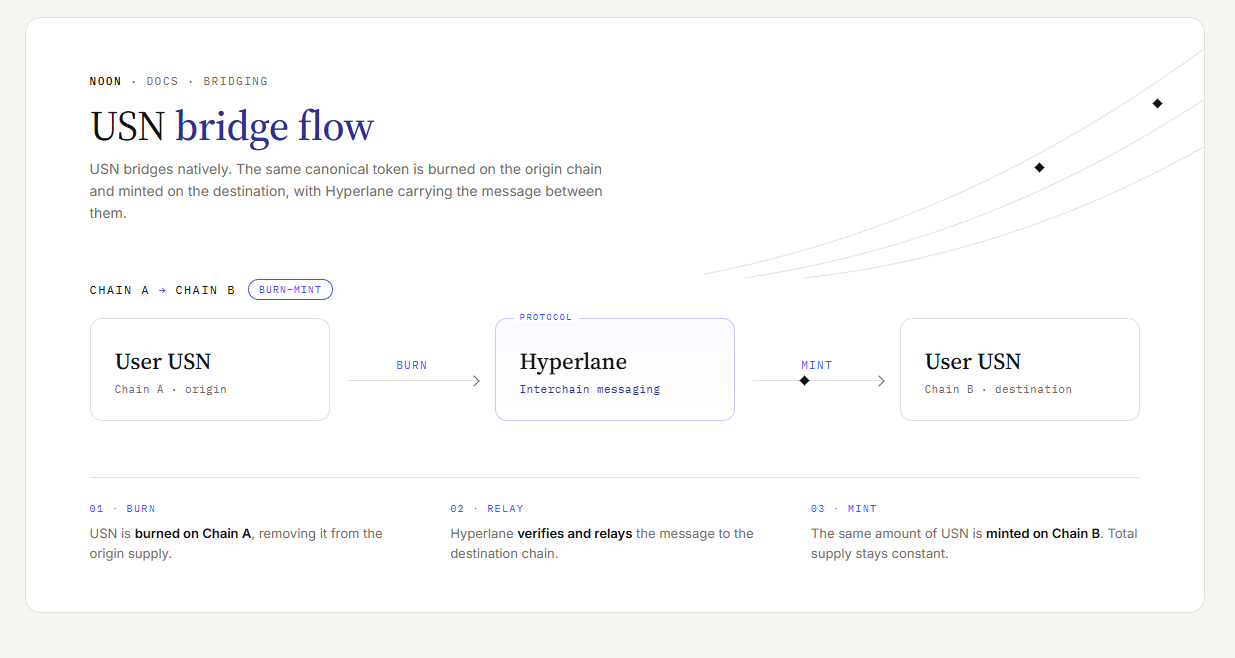
**$USN** uses a **burn-mint** mechanism across all supported chains:
1. **Burn Phase**: **$USN** tokens are burned on the origin chain
* Tokens removed from circulation
* Supply decreased on origin chain
2. **Mint Phase**: **$USN** tokens are minted on the destination chain
* New tokens created on target chain
* **Total cross-chain supply remains constant**
### **2. ****$sUSN** Bridging Architecture
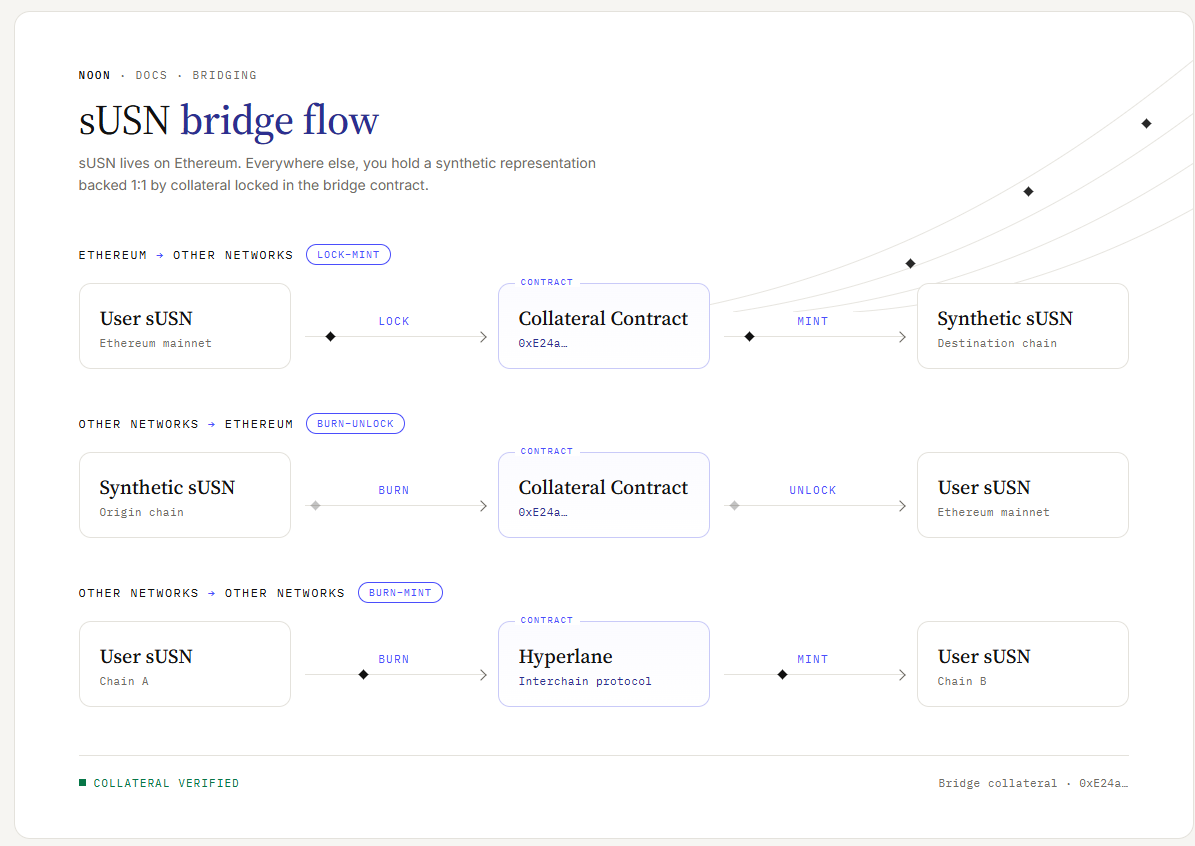
**$sUSN** uses a combination of burn lock-mint and burn-mint mechanisms, depending on the origin and destination chain.
**2.1. Ethereum → Other Networks: Lock-Mint**
When bridging **$sUSN** from Ethereum to other networks:
1. **Lock Phase**: **$sUSN** tokens are locked in the collateral contract on Ethereum
* Lock Address: `0xE24a3DC889621612422A64E6388927901608B91D`
* Tokens remain in escrow on Ethereum
* Subtract escrowed tokens when calculating total supply across all chains
2. **Mint Phase**: Synthetic **$sUSN** is minted on the destination chain
* Wrapped/synthetic representation created
* **1:1 backing** by tokens locked on Ethereum
**2.2. Other Networks → Ethereum: Burn-Unlock**
When bridging **$sUSN** from other networks back to Ethereum:
1. **Burn Phase**: Synthetic **$sUSN** is burned on the origin chain
* Removes the **wrapped representation** from circulation
2. **Unlock Phase**: Original **$sUSN** is released from the lock contract on Ethereum
* Tokens return to the user's address
* Released from `0xE24a3DC889621612422A64E6388927901608B91D`
2.3. **Other Networks → Other Networks: Burn-Mint**
* **Burn Phase**: **$sUSN** tokens are burned on the origin chain
* Tokens removed from circulation
* Supply decreased on origin chain
* **Mint Phase**: **$sUSN** tokens are minted on the destination chain
* New tokens created on target chain
* **Total cross-chain supply remains constant**
## A note on bridge risk
Moving tokens across chains depends on **bridge infrastructure** beyond the core Noon protocol.
Noon uses Hyperlane and LayerZero's lock-and-mint model to keep total supply consistent across chains. However, **cross-chain security** ultimately depends on that infrastructure performing as designed.
For the full picture of this and every other risk, alongside how Noon manages each, see [**Risks & Mitigants**.](/1.-noon-the-basics/risks-and-mitigants.md)